Thursday, July 20, 2006

Elijah and laundry

Dr. Turner was sick yesterday, so I ended up teaching three class periods. Consequently, I was able to finish up my Malachi class this morning. I have the devotional time tomorrow, and I probably will preach in Dandi or somewhere on Sunday, but other than that, my responsibilities are almost over.
I covered the 4th chapter of Malachi today. It’s mostly a warning about the coming “day of the LORD” with its judgment on the wicked and the satisfaction and joy of the righteous. It was a little bit smoother sailing than yesterday. There are several verses in chapter 3 that are difficult to translate, and therefore difficult to understand and apply. The biggest difficulty in chapter 4 is deciding whether or not John the Baptist fulfilled the prophecy of Elijah’s return in verses 5 and 6. John’s dad prophesies that he will minister in the spirit and power of Elijah, and Jesus says that John the Baptist was Elijah, if you can accept it. But John the Baptist explicitly said that he wasn’t Elijah. The answer is possibly found in Matthew 17, where Jesus says, “Elijah comes” after John the Baptist died. So, it seems that John was the fulfillment of Malachi 3:1 but not Malachi 4:5-6. Elijah may be one of the two witnesses who stand in the streets and preach for 3 ½ years during the Tribulation (if you can accept it). Aren’t you glad you read that paragraph? Time well spent.
Anyhow, there was a power outage shortly after class, so that put a damper on my plans to do laundry. I had some battery left on my computer, so I went online to check e-mail and chatted for a few moments with a high school buddy, Rick, and my erstwhile Yahoo! Spades partner, Weezy. Rick just got back from a missions trip to Yakama Indian Reservation, so we chatted about that a little, until I ran out of battery.
When the power came back on, I did enough laundry to get me through the rest of the trip. Doing laundry is a blog of its own, but the short version is: You fill 2 or 3 buckets of water from a faucet in the shower. You dump them in the washing machine and add some soap. Then you put the clothes in and start the timer. The timer ticks but the machine doesn’t agitate. You decide the load’s too heavy, so you take some clothes out. You continue taking out more and more clothes. Soon all the clothes are out, but it’s still not agitating. You worry that you burned out the motor. You go ask Mrs. Turner if there’s some trick to making the washer agitate. She suggests flipping the switch on the outlet. You go back to the bathroom and flick the switch. The washer begins agitating. You put the clothes back in. You take the jeans back out, because they’re too heavy. After a few minutes, you take some other clothes out and put the jeans back in. After a few more minutes, you take all the clothes out and drain the water into the shower. You rinse out the washer tub and add 2 or 3 more buckets of water. You put the clothes back in, sans jeans, natch, and rinse for a while. Etc., etc. You get the picture.

Tuesday, July 18, 2006

Jehoshaphat

I led devotions again today. This time, I focused on the story of Jehoshaphat from 2 Chronicles 20. If you don’t remember the story, I would encourage you to read it for yourself, but I’ll give you the synopsis with a few things I gleaned from it. Jehoshaphat was about to face a big problem. The Moabites and Ammonites were getting ready to attack Judah. Then, Jehoshaphat gets a message that the Edomites have decided this would be a good time to launch their attack as well. So, Judah is facing three armies, any one of which would stand a decent chance of destroying them. I drew from this story three keys for facing our enemies.

The first thing Jehoshaphat did was called all of the people in Judah together for a time of prayer and fasting. Jehoshaphat gathered the people in the temple courtyard and prayed, “Power and might are in your hand, and no one can withstand you. . . . We have no power to face this vast army that is attacking us. We do not know what to do, but our eyes are upon you.” The first step in facing our enemy is to acknowledge our weakness and God’s strength; we do that through fasting and prayer. When I was an associate pastor at El Dorado Springs, I really saw this put into action. When Pastor Joe first came to the church, he preached on prayer every service for weeks in a row. At first, the people thought they had made a mistake in calling such a “one-track” pastor, but eventually they got the message and began to pray. Many prayer ministries started—pastor’s prayer partners, Week of Waiting, 24 hours of prayer and fasting, 40 days of prayer and fasting. One of the most powerful ministries was Gideon’s Army. This was a group of about 50 people who met every Sunday night following the evening service. They would choose one unsaved person in the community and corporately agree to pray for that person during that week. They specifically prayed that God would bring conviction to that person’s heart. Many times, that person would be in the service the following Sunday, white-knuckling the pew in front of them. We saw many people come to Christ as a result of the prayers of Gideon’s Army.

The next thing that happened in Jehoshaphat’s story was that a prophet named Jahaziel stood up. He gave some words of encouragement that God had heard their prayer. And then he gives some strategic advice. He tells Jehoshaphat that the battle is not his; it’s God’s. Jehoshaphat won’t even have to fight. “Take up your positions; stand firm and see the deliverance the LORD will give you.” That sounds like pretty good advice in theory—just stand still and let God fight your battle for you. But it’s a lot harder to put into practice when the enemy is (or three enemies are) marching toward you. Many of us have a hard time with standing still. We have our own ideas about how our enemies should be handled, and they rarely include inaction. But that’s what Jehoshaphat had to be willing to do. So, that’s the second step—patience and faithfulness.

Finally, the morning comes, and it’s time for Jehoshaphat to go and face the battle. He chooses an unusual strategy. He puts the choir in the front lines of his army. Not swords, not lances, not cavalry, not archers—singers. They march to the battleground, singing and praising God. Apparently they got a late start, because they missed the entire battle. While Judah was still on their way, the armies of Moab and Ammon allied against the army of Edom and destroyed it. Then, a dispute broke out between their two armies and they completely annihilated each other. So when Jehoshaphat and the army/choir of Judah arrived, there was nothing left to do except pick up the spoils of war. Pretty cool, huh?

So, in case you weren’t paying attention, the three steps were:
1. Prayer and fasting
2. Patience and faithfulness
3. Praise and worship (anybody have a synonym for worship that starts with F?)
If we could really learn to put those three things into practice, we might find that God fights a lot of our battles for us and we could enjoy more of the blessings he wants to give us.

We made it a little farther in Malachi today. I only have three more days to teach, so I need to accelerate it a bit. Today, we finished up discussing his second oracle, which is about honoring God, and started into his third oracle, which is about being faithful (or, at least, not being unfaithful). In Malachi 2, he gives us a good picture of what a minister should be, probably drawn from the life of Phinehas. You may not be a vocational minister, but you might find these good qualities to develop in your own life:
1. He revered God. He always showed God proper respect and honor.
2. He stood in awe of God’s name.
3. True instruction was in his mouth.
4. Nothing false was found on his lips.
5. He walked with God in peace and uprightness.
6. He turned many from sin.

Monday, July 17, 2006

Vapi church

Yesterday presented a new challenge. Pastor Linus Justin arranged for me to come to his church and preach in the morning service. I had brought a few sermons along for just that eventuality, so I wasn’t too stressed (although I wasn’t really sure what the best approach for this particular congregation was). I had to preach through an interpreter, but I’m getting lots of practice teaching with translation in our Bible class. This was a little different, though, because Linus’s native tongue is Gujarati, but he was translating from English into Hindi. Can you imagine trying to translate from your 3rd language into your 2nd language? Of course not. You’re American; you only speak one language.
Preaching wasn’t the challenge, though. The congregation sings songs in both Hindi and English, but Linus wanted them to learn some new English songs. So he asked me to teach them. Some of you have had the distinct, um, privilege of hearing me sing; some of you perhaps remain yet unscarred. At any rate, I plunged ahead and taught them “Holy, Holy” and “Great Is Thy Faithfulness.” A capella, no less. As part of my welcome, I was again presented with flowers—this time, a heavy garland to wear around my neck.
The church meets in an apartment building. Most of the residents are Hindu, but they have not given the church any problems. The church has over 50 members. Most of them are migrants to Vapi from other parts of India; that’s why the service is held in English and Hindi. Vapi is a major industrial center, drawing workers from around the country to its factories. Often, church members have to work on Sundays, so we had about 35 in attendance. Honestly, that’s about all the chairs there were. Some latecomers sat on a carpet in the front of the church, until they were invited to take the last available chairs.
Most of the congregation came forward and shook my hand after the service. After many had departed, Linus introduced me to several of the non-Christian visitors to the service. One was a Hindu family that he is meeting with each Friday. Linus brought each member of the family to me and told me a prayer request for them. I would then lay my hand on that person’s shoulder and pray over them. One was beginning a job as a teacher; one was beginning college. Another was suffering from physical problems; another looking for a job. Finally, he introduced another lady to me who still has not converted but is reading the Bible every day. She asked me to pray that she would understand what God is trying to tell her through the Scriptures. It was so incredible to have that one-on-one contact with these people and to pray over them.
We stopped for soft drinks on the way home and chatted some more and then came back to Pardi for lunch. We had a bit of a nap, and then I had a good chat with the Turners about our future ministry endeavors. Tiffany and I will still have a lot of conversation and prayer about this before it’s all over, but I felt like this talk really did help narrow my focus a little bit.
For the evening meal, we went to the house of Seema’s family. Seema is Linus’ wife. The food was excellent, and topped off with some ice cream. We spent some time looking at the wedding photos of Seema’s brother Anand and his bride Joyana (who was there also). It looks like there are a lot of similarities with American weddings, but a few differences.
This morning, I led the devotional time. I talked about the confrontation between Elijah and the prophets of Baal on Mt. Carmel. I have used this a few different places, so I may have blogged about it before. If so, just hear it again. Here’s the short version. 1. Elijah preaches a sermon. It’s a great sermon, but the peoples’ response is silence. 2. Elijah proposes a program. He suggests a contest between Yahweh and Baal; the peoples’ response is: “Yeah, that’s a good idea.” 3. Elijah prays and God shows up. God sends fire that consumes the sacrifice, the wood, the rocks, the dirt, the water. The peoples’ response? They fall on their faces and say, “Yahweh is God! Yahweh is God!” Moral of the story: You can preach great sermons, you can have wonderful programs, but if you’re going to really see people respond, you’re going to have to pray for God to show His power.

Sunday, July 16, 2006

Vapi visit


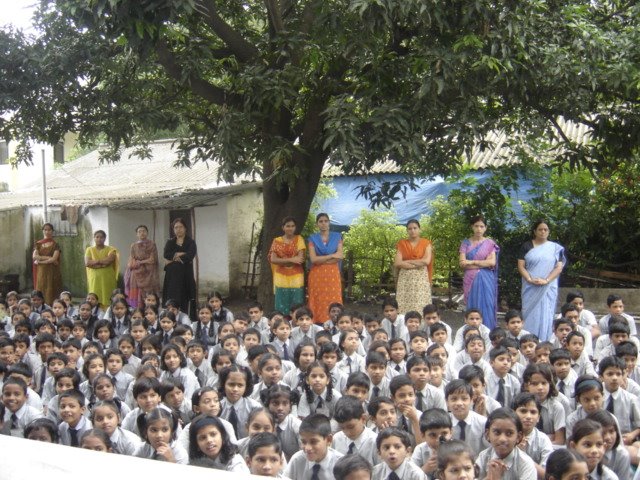
This morning, we went to visit the Wesleyan English Medium School in Vapi. We have over 700 students attending, from nursery to 10th standard (whatever that means). We had a quick look inside their computer lab and then were ushered onto a dais, where we looked out at the entire student body gathered before us. The students had charge of a special welcome program for us. They gave little speeches of welcome, sang a welcome song, sang a prayer song, personally welcomed each of us and gave us each a bouquet of flowers. Then, each of us had to make brief remarks to the students. Finally, we were released from being public spectacles and allowed to continue touring the school building.

Thursday, July 13, 2006

Malachi's First Oracle: Respond to God's Love

I woke up this morning at about 5:30. The Turners were up shortly thereafter, and we had breakfast together. At 8:30, we met with the students for a devotional time. Dr. Turner is doing a series of devotionals on life lessons from the story of Noah. He will give devotionals for the rest of this week. I’m not sure but I may be in charge of giving devotionals all next week.

I teach the first class period from 9:00 to 9:45. Yesterday, I gave the students a bit of an introduction to the book of Malachi. Today, we began to tackle the actual content. It’s a little challenging to teach with a translator, but Linus does an excellent job. We only covered the first 5 verses of the book today, but because the book only has about 45 verses, we should be right on track. I’m not sure I can actually fill 10 days of class with the content I have right now, but we’ll see. I have about 32 pages of notes, but I’ve gone through 7 of them in 2 days. The students seemed to be tracking along, and some even responded when I asked for questions at the end.

The first five verses of Malachi are about God’s great love for his people. Israel had enjoyed many, many blessings from God. He had chosen, by his own power and grace, to bless Jacob’s descendants more than he blessed Esau’s descendants. To Israel, he had given the Law, the temple, the priests, the judges, the prophets, etc. Both Israel and Edom had become wicked, and God punished them by sending them into captivity in Babylon. But, because of God’s great love, he brought Israel out of captivity and restored them to their homeland. One hundred years passed. Israel was under Persian domination, the crops were less than satisfactory and God had not yet ushered in his Messianic kingdom. In the face of these negative circumstances, Israel began to complain that God didn’t love them. They overlooked 1000 years of God’s loving provision and blessing to complain about the few things they didn’t have in the present. They forgot about the covenant God had made with Abraham and Isaac. They forgot how God chose them before Jacob was even born. They forgot how God delivered them from slavery in Egypt. They forgot how God had protected them in the wilderness. They forgot how God had given them the land of Canaan. They forgot how God had sent judges to deliver them from the messes they got themselves into. They forgot how God had brought them out of captivity, while he left Edom under Babylonian bondage. They forgot how God had allowed them to rebuild their temple, while the Edomites were again attacked by the Nabatean Arabs and forced out of their land. Their current circumstances blinded them to the overarching love God had shown them.

Malachi does a great job of pointing out the ingratitude typical of the human experience. God gave Adam and Eve thousands of trees in the Garden, but they fixated on the one tree they weren’t allowed to have. Are you there? Do you focus on one negative in your life, forgetting a long history of God’s gracious acts toward you? I know I really struggle with cynicism and a complaining spirit. I’m praying that God will help me to remember how he has worked in my life, so that I will never ask accusingly, like Israel did, “How have you loved us?”

Well, enough preaching for one blog. After class, I got online and posted my blog from last night and read a few e-mails. I tried to talk to Tiffany, but she was probably putting Elijah down for his nap. I went back to the apartment and continued class preparation. I think I’m more or less prepared for the rest of the time I will spend here. We talked a little about my plans for the end of this trip. I don’t fly out until the evening of the 24th, but I may try to go to Mumbai on the 23rd and spend the night in a hotel. That would give me a chance to run out and get the geocache on Elephant Island, do some souvenir shopping, and still get to the airport in plenty of time. Hopefully, I could leave my luggage there for a while, so that I don’t have to lug it all over the city.
I’m still keeping my ear to the ground about the situation in Mumbai, though. If things heat up any more, I will scrap the whole thing, go directly to the airport on Monday evening and get out of the country with the least bother possible.

I’m really hoping I get a chance to do one day of sightseeing. I really am seeing a very tiny slice of India. This village is about 50,000 people, but we don’t really leave the campus. We may do a little grocery shopping or something tomorrow; I’m not sure.

Wednesday, July 12, 2006

India

I’m in India! On Monday afternoon, I flew from Manila to Bangkok on Thai Airways. In the Bangkok airport, I met Dr. and Mrs. Paul Turner, the Asia area directors for Global Partners. We flew on from Bangkok to Mumbai, arriving around 10:30 p.m. India time. After a long wait at the baggage carousel and a stop at the currency exchange to buy some rupees, we were greeted by Dr. Samuel Justin and his son Linus. For many years, Dr. Justin was the regional superintendent for the West India conference of the Wesleyan Church; his son Joel now holds that office. We got into their vehicle and immediately headed for the village of Pardi in Gujarat State. It was raining (this is monsoon season), so it took a little more than three hours for us to reach our destination. The time here is 2 ½ hours earlier than in Manila, so we had basically been up all night, although I did doze off and on along the way. When we arrived in Pardi, the Justins showed us to our apartment. It’s a two-bedroom apartment in a building consisting of a chapel, classrooms, etc. The accommodations are a little primitive by Western standards but very satisfactory for our needs. I put up my mosquito net, climbed into bed and fell asleep immediately.

Tuesday was, more or less, a day of rest and preparation. After we were all up and around and had a very late breakfast, we headed to Vapi, a nearby industrial center. We went to a grocery store and picked up some supplies—breakfast items, snacks, etc. While there, we were privileged to meet Linus’ wife Seema, who is the headmistress of the Wesleyan English Medium School, as well as one of their computer teachers. The school has just added the tenth standard and has about 700 students. I was given a very attractive school magazine with lots of color photos, student artwork, poems, etc. We also stopped at a local pharmacy, where Mrs. Turner ordered some medicine, available here at nearly ¼ of U.S. prices. We spent most of the rest of the day in rest and preparation for classes. We are taking our lunch and supper with the Justins. I can’t easily describe the food, except to say that it is very agreeable. We usually have rice of some variety, although it is different from what we eat in the Philippines. There is always chapatti—bread made by grinding grain into flour and adding water to make dough, which is then kneaded, rolled, and baked flat. There is also some kind of similar bread that is fried in oil. The main protein dish is usually some kind of meat or lentil stew, flavored with curry and/or other spices.

Saturday, July 01, 2006

62%

Tiff's been complaining about the fact that our back yard turns into a swamp every time she does a load of laundry, and I wasn't too thrilled about it myself. Today, I decided it was time to fix it. The current situation was a 2 1/2 inch elbow coming out of the wall with a pipe going down to the ground and an elbow shooting the water out into the yard. I told Jasson, our helper, that he could start digging a ditch, because we would lay new pipe to take the water out to the treeline. I went to work in the library until the battery on my laptop ran out. I came back and got Jasson and we went to VJ Cruz hardware store. They said they didn't have any 2.5" PVC, only 3". So we jumped back in the car and went to Northern hardware store. I told them I needed 2.5" PVC. The guy asked me blue or black. I was, like, I don't care; it's going to be underground. Apparently, though, the color corresponds to the quality. All they had in 2.5" was blue which was going to be more than $1 per foot and I needed about 40 feet. There wasn't much option though, so I told them I'd take it. "I need 3 couplings," I said. A little research revealed that they didn't have any. The proprietor's wife said I should use 3" for drainage anyhow. Again, I didn't have much choice, so I went for the 3" pipe. Fortunately, it was available in black--much cheaper. And they had the elbow that I needed. Eventually, we were back at campus with everything we needed. The only tricky part was trying to wedge the 3" pipe under the elbow barely protruding out of the wall. It just wasn't budging. I thought the elbow was metal (why I would think this, I have no idea). I tried prying it out a little with a crowbar. Of course, it was PVC and it shattered. So now, I just had a 2.5" hole in the wall. I got the boys' monitor there to help. He decided we could melt the end of a 2.5" pipe, stick it in the hole and attach an elbow to drain into the 3" pipe. So, we were running back and forth to the kitchen, melting pipe over the stove and going back outside to try to cram it in the hole. I think it's going to work. We'll see on Tiff's first big laundry day.

Thursday, June 29, 2006

59%

Here's a little visitor we had above the door to our bedroom last night:

Wednesday, June 28, 2006

57%

Right now, I'm watching Charlie Rose's interview with Bill and Melinda Gates and Warren Buffett. I'm just blown away by so many aspects of this story. Warren Buffett said that he and his wife decided many years ago that they would give their wealth to society, long before it was apparent how large that fortune would be. He pointed out that those who are going to spend their money ought to give their wealth now, but those who are going to compound their money ought to give their wealth later. The Gates Foundation is projected to save 10,000,000 lives in the next 10 years just through one vaccination program. That just blows my mind! Whatever we may think of these individuals, it's hard to fault their stewardship. And, at least on the surface, they seem completely sincere and of pure motivation. Another thing that interested me was that both Gates and Buffett commented about times in their lives when the other one had given them a book. I guess it really is true that "leaders are lifelong learners." This is why I'm kind of passionate about this library project. I want the students here at the Bible school to have a library that will really inspire them to read and learn and keep on reading and learning.

We had a good discussion in missions today about the importance of prayer. It made the kids giggle nervously, but we stopped in the middle of class and prayed for "kings and all those in authority," especially those who were involved in the persecution of the church. I have the feeling it was the first time most of them had done that.

Monday, June 26, 2006

55%

Going to Manila this weekend meant that I wasn't totally prepared for class today. Tiffany had to go to the market, and I was struggling to finish a PowerPoint for missions class while keeping Elijah entertained. They ring the bells about 10 minutes early, so I was really pretty stressed. I got it done just after Tiff came home, and I got to class almost on time. I guess it's a good thing that I have that class on our back porch.

Today, we discussed the first chapter of Acts. I've made the point before in other venues that Acts 1:8 seems to indicate that one of the primary purposes for the giving of the Holy Spirit is to empower us for witness. Our tradition has often perhaps overemphasized the purifying work of the Spirit to the detriment of His empowering work. We talked a little bit about what Jerusalem, Judea and Samaria, and the ends of the earth mean to us today in the Philippines, both geographically and culturally. I had each of the students state their cultural background (a bit of an eye-opener, actually) and then think of another Philippine tribe that was similar yet different and then of another tribe that was very different. I hope that I'm instilling in them at least a bit of the idea that God's plan from the beginning was a universal faith. I can't always tell, but I think they're starting to get it. We'll see how much of it sticks come exam time, or more importantly, when they're out in the pastorate.

I had to go to the bank to withdraw some missions funds to pay for my airline tickets. While I was in Urdaneta, I also needed to pick up some baby wash. I decided that I had time to get a massage while I was there. I think my masseuse was also running the front desk, so it took longer than usual. Then I ran over to the supermarket to get the baby wash. I picked it up and went to the "8 items or less" lane. This is perhaps the most abused idea in the Philippines. The people in front of me had a cart. Two spaces farther up in line was a lady who had maybe "80 items or less." After fuming for a while, I finally went up to that lady and asked her if I could go ahead of her, since I only had one item. She agreed. Then the cash register tape was messed up, so anyhow . . . an hour late getting home for lunch.

I finished up my notes on Plato for philosophy class, but I didn't get to him today. I decided that I would give my students a little oral quiz to see how they were tracking with my lectures. There were 15 questions, and the scores ranged from 2 to 15, with an average a little bit over 8. So, either I need to make some adjustments or they do. We talked about Socrates' apology, trial and death today. I can't agree with everything Socrates said and did maybe, but I think I agree with his central theses: "The unexamined life is not worth living" and to live virtuously is the highest good.

55%

Going to Manila this weekend meant that I wasn't totally prepared for class today. Tiffany had to go to the market, and I was struggling to finish a PowerPoint for missions class while keeping Elijah entertained. They ring the bells about 10 minutes early, so I was really pretty stressed. I got it done just after Tiff came home, and I got to class almost on time. I guess it's a good thing that I have that class on our back porch.

Today, we discussed the first chapter of Acts. I've made the point before in other venues that Acts 1:8 seems to indicate that one of the primary purposes for the giving of the Holy Spirit is to empower us for witness. Our tradition has often perhaps overemphasized the purifying work of the Spirit to the detriment of His empowering work. We talked a little bit about what Jerusalem, Judea and Samaria, and the ends of the earth mean to us today in the Philippines, both geographically and culturally. I had each of the students state their cultural background (a bit of an eye-opener, actually) and then think of another Philippine tribe that was similar yet different and then of another tribe that was very different. I hope that I'm instilling in them at least a bit of the idea that God's plan from the beginning was a universal faith. I can't always tell, but I think they're starting to get it. We'll see how much of it sticks come exam time, or more importantly, when they're out in the pastorate.

I had to go to the bank to withdraw some missions funds to pay for my airline tickets. While I was in Urdaneta, I also needed to pick up some baby wash. I decided that I had time to get a massage while I was there. I think my masseuse was also running the front desk, so it took longer than usual. Then I ran over to the supermarket to get the baby wash. I picked it up and went to the "8 items or less" lane. This is perhaps the most abused idea in the Philippines. The people in front of me had a cart. Two spaces farther up in line was a lady who had maybe "80 items or less." After fuming for a while, I finally went up to that lady and asked her if I could go ahead of her, since I only had one item. She agreed. Then the cash register tape was messed up, so anyhow . . . an hour late getting home for lunch.

I finished up my notes on Plato for philosophy class, but I didn't get to him today. I decided that I would give my students a little oral quiz to see how they were tracking with my lectures. There were 15 questions, and the scores ranged from 2 to 15, with an average a little bit over 8. So, either I need to make some adjustments or they do. We talked about Socrates' apology, trial and death today. I can't agree with everything Socrates said and did maybe, but I think I agree with his central theses: "The unexamined life is not worth living" and to live virtuously is the highest good.

Wednesday, June 21, 2006

53%

The past couple class sessions of Missions 1, we have been doing a study of the book of Jonah. We were looking at chapters 3 and 4 today. Two things really struck me funny as we were reading chapter 4. One was the place where God asks Jonah, "Do you have a right to be angry about the vine?" And Jonah has the gall to answer: "I do." The vine was a pure act of grace on God's part, but Jonah just assumes ownership and is greatly offended when God takes the vine away. The other thing that made me laugh was the phrase "God provided a worm." What I had never noticed before was what a beautiful object lesson the whole story of the vine and the worm were. The book of Jonah is just filled with an intertwining of the themes of God's sovereignty and His grace. For example, we see God's plan to judge Nineveh, his power over the weather, and his control of the fish's behavior up against his grace in giving Nineveh a chance to repent, giving Jonah a second chance to go to Nineveh, etc. Anyhow, you come down to chapter 4 and you see God act in sovereignty and grace to provide a vine (just to make Jonah comfortable) and a worm (to make him uncomfortable?). Jonah is sitting there fuming about God apparently changing his mind. He's mad that God repented of his threats toward Nineveh, and now he's mad that God repented of his provision of shade for Jonah. You can almost picture the people of Israel reading this book. Chapter 1: "That stupid guy. Don't you know you can't run away from God." Chapter 2: "Ah, this sounds like the Psalms. Now, he's acting a little more like a prophet." Chapter 3: "Um, I'm getting a little uncomfortable. Why isn't God destroying the Assyrians?" Chapter 4: "What a moron. Won't he ever learn that . . . hey . . . what's going on here? This book isn't about Jonah after all, is it? It's a book about me, about my racism, against my hoarding God to myself, about . . . uh oh." And it closes out with that great question: "Should I not be concerned about that great city?" I've seen Jonah; I've been Jonah. God help me!

I preached in chapel today. Our theme for the month is "What on earth am I here for?" which is bad grammar, but Rick Warren used it, so I guess that sanctifies it. Anyhow, there have been a lot of perspectives shared this month, but I decided to focus on the idea that I am here on earth to glorify God and enjoy Him forever. Yeah, that's not original to me. Anyhow, it was a sermon about worship, and it was a little different from my usual style, a little more teen-friendly, I hope.

Tuesday, June 13, 2006

44%

My dad is in charge of a new missions group at our home church, so he asked me last night for some input on what makes a church a good supporting church. Obviously, prayer support and financial support are our most basic needs. But what can a church do beyond that? I think of the church that does the best job of helping us feel like real partners. They send us their church newsletter. Twice a year, they feature us in a Sunday morning service. Last month, they did a live phone call with us during the service. They also feature our ministry in their newsletter that month. They remember us at birthdays and Christmas. They have a notebook in their church building, containing our newsletters and photos. During the months when we are the focus, they put a box for cards, letters, donations, gifts, etc. Although we've only been to that church once, they feel like a second home. Dad asked me about whether people sending letters was an encouragement or just adding the burden of answering them. I think we always like getting correspondence (even via e-mail). It's good if the person doesn't expect a lengthy personal reply. If they send an e-mail, it's easy to at least jot a few quick lines back.

He also asked about guidelines for work teams. Here were my ideas:
Come for a long time, not 5 days (especially if jet lag will be involved).
Come with the attitude of learners.
Come to serve the local people, not the missionaries.
Come prepared to leave your comfort zone. That means, eat the local food! Get out of the mission house, etc.
Monetary gifts are always appreciated, but the people really want to build a relationship with you. Don't just foster dependency. Get to know the people and then let God direct you as to whether you ought to give something or not.

Thursday, June 08, 2006

38%

I don't teach any classes on Thursdays, so I thought this would be the ideal time to go get my car repaired. I knew it probably wouldn't start, so I went and recruited some students to help push the car out of the driveway. Actually, I recruited one student, who recruited someone else, who recruited four blind guys. Anyhow, they pushed the car out of the driveway and halfway around campus, but I couldn't ever get the engine to catch. So I sent a student in search of jumper cables and texted someone to see if he had any. There were none to be found, but the student returned carrying another battery. We disconnected my battery and then came to the realization that the replacement battery was too big to fit into my vehicle's battery compartment. Finally, I went and got Pastor Alex, who was just leaving to teach a class; he dropped everything, though, and came with me, bringing along a length of electrical wire. With that wire and a couple of vise-grips, he improvised jumper cables and hooked my vehicle up to the battery sitting on the ground next to the car. After a couple of tries, that got me started.

I drove to Carmen, where the mechanics seem to have a rather unorthodox and, I think, unreliable method of testing electrical components. At any rate, they recommended a new battery, and, crossing my fingers and praying that my alternator is still good, I bought one. I had it installed and drove home. Tomorrow morning, we'll find out if that was the problem.

I finished the Powerpoint for my missions class tomorrow, and then headed back to the library for more work on the card catalog. The task is even more dismaying since the students have arrived. They disorganize the books as fast as or faster than I can organize them. I talked to the librarian last night about implementing a new policy. Currently, students are supposed to reshelve their own books. This is NOT working. Hopefully, we are switching to a system where the assistant librarians do all the reshelving. I don't know, though; some of the current reshelving seems to be more malicious, than accidental. The card catalog will be basically useless if we can't get the students to put the books back where they belong.

We had our first chapel service tonight, and it lasted about 2 hours. The faculty was supposed to sing the special song, but we didn't practice in advance at all. They announced what the song was as we were heading up to the platform. I had never even heard the song before, so I peeled off and watched Elijah instead.

Wednesday, May 24, 2006

The Reddest Tape

If you don't want to read my rant about third world bureaucracy, this would be an excellent time to navigate away from this page.

We made a trip to Manila on Monday to pick up our I-Cards. We had perfectly serviceable ACRs (Alien Certificates of Registration) but the Philippine government decided we need an ID card too (although they seem to go back and forth on that). We had been to Manila over a month ago, paid our fees and did all the paperwork. The I-cards were supposed to be finished in two weeks. So, we pull up to immigration on Monday, and I walk in with my little claim stubs.

The guard stops me at the front desk and tells me I can't come in because I'm wearing shorts. It's 90 degrees out. I'm wearing shorts, and I packed a pair of shorts. I go back out to the car and send Tiffany in with the claim stubs. She went to the line; there were 2 people in front of her. At least 30 minutes later, she made it to the front of the line. The lady at the desk said, "Did you pull your papers yet?" Tiff said, "I don't know." The lady left for about 10 minutes. She came back and gave Tiff back all the forms and receipts we had turned in a month ago and sent her to the third floor of the next building.

Tiff waited in a short line there, got to the front and handed them her forms. They said their computer was down, so they couldn't check the status of the forms, but she could just hand them in and they would call her name when they were ready. She sat for a while; after a few minutes, they started calling names. Tiffany could see our pictures on the computer, and then they called her up and told her to turn in the stubs, which the lady in the first building had kept.

So Tiff went back to the first building and waited in line again. The guy in front of her took about 10 minutes. The lady gave her the stubs and Tiff went back to the other building.

Once she had her stubs, her forms were signed by the big boss man and she was sent to another table. The man there told her our papers were approved and we could come back on Friday to pick up our I-cards! Tiff explained we were from the provinces and needed them by Tuesday. He said, "I don't know; I'll check with the chief. Are you a missionary? etc." Finally, we were told to come back at 10:00 on Tuesday for the 11:00 printing of I-cards, just bringing the stub.

10:00 the next morning, we were at immigration. First building, wait in line, lady looks it up in the computer, says we're not approved. Second building, wait in line, sent to another desk, "you're approved; go see Esther." Wander around, looking for Esther. Told to redo everything we already did the day before. They look around for the forms, finally deciding they're locked in somebody's desk who will be there at 2:00.

2:00 we return to immigration. Second building, Esther's desk. They look us up in the computer--ready to print. First building, wait in line for a long time. "They're ready to print. Madam, I'm sorry but our printer is [unintelligible]. We can't print right now." Come back Thursday!

GRRRRRRRRRRRRRR!!!!!!!!!!!!!!!!!!!!!!!!

Monday, May 15, 2006

19%

Despite dozens of hours already working on computerizing the school library database, I estimate that I'm only about 19% completed with the task. I set myself back a little today by suggesting to the librarian that we remove from the collection a number of books that I had already catalogued. They were all just portions of the Living Bible, which we already have in our reference section. There were probably more that I could have removed, but that was depressing enough.

The progress is slow, because I not only have to enter the data into the database, but I usually have to make a new spine label for the book, because it either doesn't have one or has one that is incorrect. Furthermore, most of the books aren't in order currently, so I have to shuffle them around as I go along. The library is filthy, too. I think the students cleaned it at the end of the school year, but it started building up dust fast. The librarian came and helped me for a few hours today, and she also did a little cleaning.

Thursday, May 11, 2006

preparation

I think it's always a challenge for teachers to stay motivated during the summer, but I did a decent job today, I think. I was able to get a couple of solid hours of sermon preparation in this morning. I'm preaching at college church this Sunday. It's Mother's Day, of course, so I'm trying to do something along that theme. I'm focusing on Naomi, who is more famous as a mother-in-law than a mother, and about whom very little is explicitly said. So, I'm having to infer things about her culture from Ruth's response to her. This is a bit stretching for me, but I think it's starting to come together. Hopefully, tomorrow I can put a little more meat on the skeleton and polish it up a little.

I'm teaching philosophy this next semester, so I'm reading a real entry-level text to brush up on the basics of the material. The book I'm reading approaches philosophy from a chronological standpoint, so I've read up to the medieval philosophers right now. The text that has been used in that course in the past is arranged topically, so I'm trying to figure out how to integrate the two. I've actually toyed with doing a history of philosophy for half the semester and a more conceptual look during the second half, but I'm not sure I have the time or the skill to make both halves cohesive without being redundant. A lot of my reading done today was done on the move, as I followed Elijah on his wanderings around campus and frequently interrupted by "No. Elijah. No. No. Stop. No." Such talent for cruelty to cats at such a young age!

I think I'm really getting a more crystallized idea of what to do with my Missions 1 course.

Monday, May 08, 2006

vulnerability

This will be a little repetitive of a previous post, but we worked today to distill a list of a few key characteristics of healthy relationships in the Philippines. Here's what we came up with:
1. It is good to greet a person. This is usually done with a handshake, although women may use beso-beso and very close friends may embrace. Asking someone “Where are you going?” or “When did you return?” are just formalities that don’t necessarily require a definite response. However, when someone asks “Kumusta ka?” they are expected to listen to the answer with genuine interest.
2. Generosity is one of the trademarks of a true friend. If someone has the power to help a friend and refuses, that may be considered offensive. Similarly, you can expect that your friend will loan you anything you need.
3. It is appropriate to drop in on a friend unannounced, although it’s okay to call or text ahead. When you arrive, your friend should stop what they are doing and give their attention to you. If they are eating a meal, they should invite you to join them.
4. You shouldn’t isolate yourself.
5. When you are at a friend’s house, you should make yourself at home.
6. You should address even strangers as manong or manang, if they are clearly older than you. It’s okay to use tito and tita with those who have children older than you. You can refer to the very old as tatang or nanang. If in doubt, use the younger term of address.
7. You may offend a friend if you decline an invitation without a valid reason.
8. You may offend a friend by violating their trust.
9. You may offend a friend if you deny them something—if they ask for help and you don’t help them.
10. You may offend a friend if you talk about them behind their back.
11. It is okay to approach someone directly if you have a problem with them, but you should be careful not to hurt their feelings. It is also okay to use a third party, if you don’t feel comfortable approaching the person directly.
12. If there is a sickness or death in someone’s family, a good friend will stay with his friend to comfort him and assist him.
13. When you go on a trip, it is appropriate (and sometimes expected) to bring back pasalubong for your friends, usually food items.

We also did some reading about exposure and concealment of vulnerability. It's hard to really define Philippine culture on that continuum. I think people here generally try not to hurt other's feelings, but in some ways, they can be more blunt than Americans. I thought of a situation where a man came into a meeting and began to present what appeared to be somewhat of an insurance scam. I think the American response would have been to thank the man and dismiss him. The response here was to ask lots of probing questions that revealed that the deal probably wasn't completely reliable. Without specifically demeaning the presenter, they made it clear that they weren't interested in his offer.

Also, Filipinos do seem to be interested in competition at least at some level, and they also seem willing to compete in things where they don't necessarily have a great chance of succeeding. The prime example of this is videoke. I could relate numerous instances of people singing loudly in public despite an apparent lack of singing talent. However, I am curious now. In some societies, students do not take tests if they think they will fail and do not turn in written assignments if they feel that they will do poorly on them. I don't have enough information to say if that's what's happening here, although there certainly are a number of students who fail to complete their requirements.

Saturday, May 06, 2006

More interviews

I did some airline ticket shopping today. Our area director wants me to go to India in July to teach some courses. The idea excites me, but it is 3 weeks of missed classes here and, as far as I can tell, a big chunk of change to get there.

We interviewed two more cultural consultants today about relationship issues in the Philippines. Some answers come back with striking consistency, but on other questions, the answers are all over the board. Sometimes, we are so enculturated in our culture that we have trouble identifying its characteristics. We think there's nothing that would interest a foreigner, because we assume they do it the same as we do. So when we ask, "How do you greet a friend?" we get answers like, "Oh, just the same as you do." That's not very helpful, and it's probably not very accurate. I guess that's why we're trying to get various perspectives.

One question that's pretty important but gets varied answers concerns our status in The Wesleyan Church of the Philippines. Some tell us that we are on a par with the general leaders, which is what almost seems to be the case in actual practice. Others say that we are on the level of the pastors, which is probably what the ideal situation would be.